TacticalPontoon Trigger Theory: connectors #1
Glock Connector Geometry Explained: Why Pull Weight Does Not Tell the Whole Story
Glock connector geometry describes how the connector controls the trigger bar’s movement from the beginning of the trigger press through striker release and reset.
The shape, angle, and position of those surfaces influence when the trigger bar begins to move inward, how resistance develops at the wall, how far the trigger moves before the break, and how the system behaves during reset.
Throughout this article, when I refer to geometry, I’m referring to the mechanical relationship between interacting parts—not simply the physical shape of an individual component.
That is why two Glock triggers can measure nearly the same pull weight and still feel completely different.
A trigger-pull gauge measures force.
Your finger experiences movement.
That difference matters.
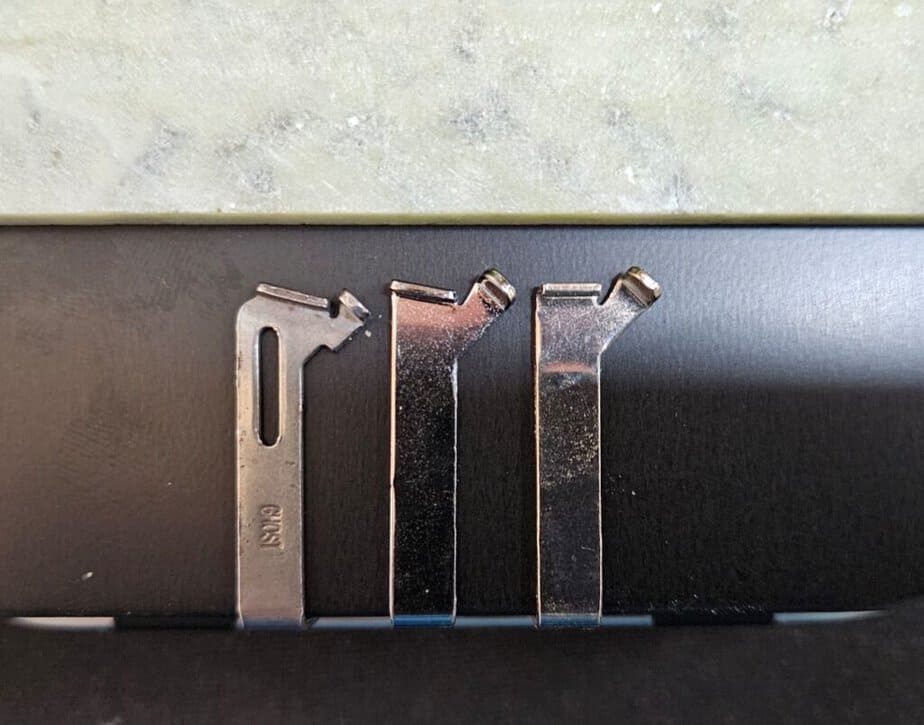
What I Look at When Testing a Glock Connector
When I evaluate a connector, I do not simply install it, pull a gauge, and call the lowest number the winner.
I look at:
- Wall location
- Break consistency
- Trigger-bar movement
- Reset force
- Reset distance
- Overtravel
- Surface finish
- Contact pattern
- Striker-release timing
Whenever possible, the connector is evaluated in a controlled trigger system so that only one variable changes at a time.
That removes some of the guesswork and makes it easier to see what the connector is actually contributing.
Observation #1: Identical Pull Weights Can Feel Completely Different
Two connectors can produce nearly identical readings on a trigger-pull gauge while creating very different experiences for the shooter.
Why?
Because pull weight measures the amount of force required to complete the trigger press. It does not tell you how far the trigger must travel from the wall to the break or what that movement feels like along the way.
Your finger may experience that movement as:
- Creep
- Roll
- Squish
- A defined wall
- A sudden break
- A long transition between the two
You know the difference when you feel it.
One trigger reaches the wall and breaks with very little additional movement. Another reaches what appears to be the wall, continues moving, loads a little more, and finally releases.
The gauge may display the same number. Your finger knows they are not the same trigger.
That difference is geometry.
Observation #2: The Connector Never Works Alone
This is probably the single biggest misunderstanding surrounding aftermarket Glock triggers.
Changing only the connector while leaving every other variable untouched is like trying to tune an orchestra by replacing one violin.
That does not mean a connector swap is useless.
It can be the beginning of something great.
It can also be the change that makes Observation #1 painfully obvious.
The connector interacts with:
- Trigger-bar geometry
- Cruciform engagement
- Trigger-shoe leverage
- Spring forces
- Overtravel
- Component tolerances
- Contact surfaces
- The intended purpose of the trigger system
A connector that works extremely well in one combination may feel completely different when installed with another trigger bar, shoe, spring setup, or frame.
This is why there is no honest answer to the question:
“What is the best Glock connector?”
There is only a connector that works properly within a specific combination.
Observation #3: Connectors Often Get Blamed for Cruciform Problems
Connectors frequently receive a bad reputation when the real problem is cruciform engagement or the relationship between the trigger bar and the rest of the firing mechanism.
That can show up as:
- Inconsistent reset
- Failure to reset
- Excessive movement through the break
- Unintended multiple discharges
- Bump-fire-like behavior
- An unsafe level of engagement
These are not characteristics to ignore, accept, or “shoot through.”
Any time a connector or another fire-control component is changed, the engagement should be inspected using an armorer’s inspection plate and verified through the appropriate safety checks.
A connector can change how the trigger bar moves and releases. That means a component swap can reveal an existing tolerance problem or create a combination that no longer maintains proper engagement.
The goal is not merely to make the trigger lighter.
The goal is to create a better trigger while keeping the system mechanically sound.
Common Myth
A 3.5-pound connector produces a 3.5-pound trigger.
Reality:
Connector names are product labels, not guaranteed trigger weights.
Actual pull weight is the result of the complete trigger system interacting with the tolerances of the individual pistol. The connector is only one variable.
TacticalPontoon Does Not Simply Recommend a Connector Swap
Go back to Observation #2.
The connector never works alone.
That is why I build complete trigger systems.
Every geometric relationship has to work with the next. The connector, trigger bar, shoe, springs, overtravel control, contact surfaces, and engagement all have to work together to create the result I am looking for.
Installing a different connector may improve one characteristic while making another worse.
It may reduce measured pull weight but add movement after the wall.
It may create a sharper break but weaken the reset.
It may feel excellent in one pistol and completely wrong in another combination.
A complete system allows me to control more of those variables instead of hoping that one replacement part solves everything.
Why the Heisenberg Is Built as a Complete System
The Heisenberg Competition System is not successful because it contains one magical connector.
It works because the connector has already been paired with the trigger bar, trigger shoe, spring combination, overtravel control, and the break characteristics I want the complete system to produce.
The connector geometry has already been evaluated.
The component relationships have already been tested.
You’re buying the conclusion of the engineering, testing, and component selection that came before it.
TacticalPontoon Standard #1
Trigger feel cannot be judged by pull weight alone.
A trigger-pull gauge measures force.
Your finger measures movement.
Understanding the difference is the first step toward understanding Glock trigger performance.
Key Points
- Connector geometry influences trigger feel more than pull weight alone.
- A trigger-pull gauge measures force, not movement.
- The connector must be evaluated as part of the complete trigger system.
- Pull weight alone cannot predict wall quality, break quality, or reset characteristics.
- Safe trigger performance depends on proper engagement and system compatibility.
Excellent information!